The 2021–2027 State–Region Planning Contract (CPER), as part of the Campus Nouveau Siècle project, includes the creation of a dedicated repository to bring together the University’s heritage collections, which have until now been dispersed across the various departments of the Université de Caen Normandie. Among these collections is a set of historic herbaria from the former Institute of Botany. As part of the Campus Nouveau Siècle project, these herbaria will be transferred to the collections and repository of the University’s Library and Learning Resources Centre (Service commun de la documentation, SCD). Combining their expertise, the MerSea research laboratory and the SCD were jointly awarded funding through the 2025 « Enhancing Scientific Heritage Collections » call for projects launched by the French Ministry of Higher Education, Research and Space, to support the digitization, long-term preservation, and open access dissemination of the University’s seaweed herbaria.
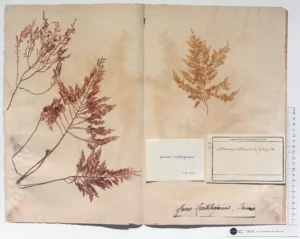
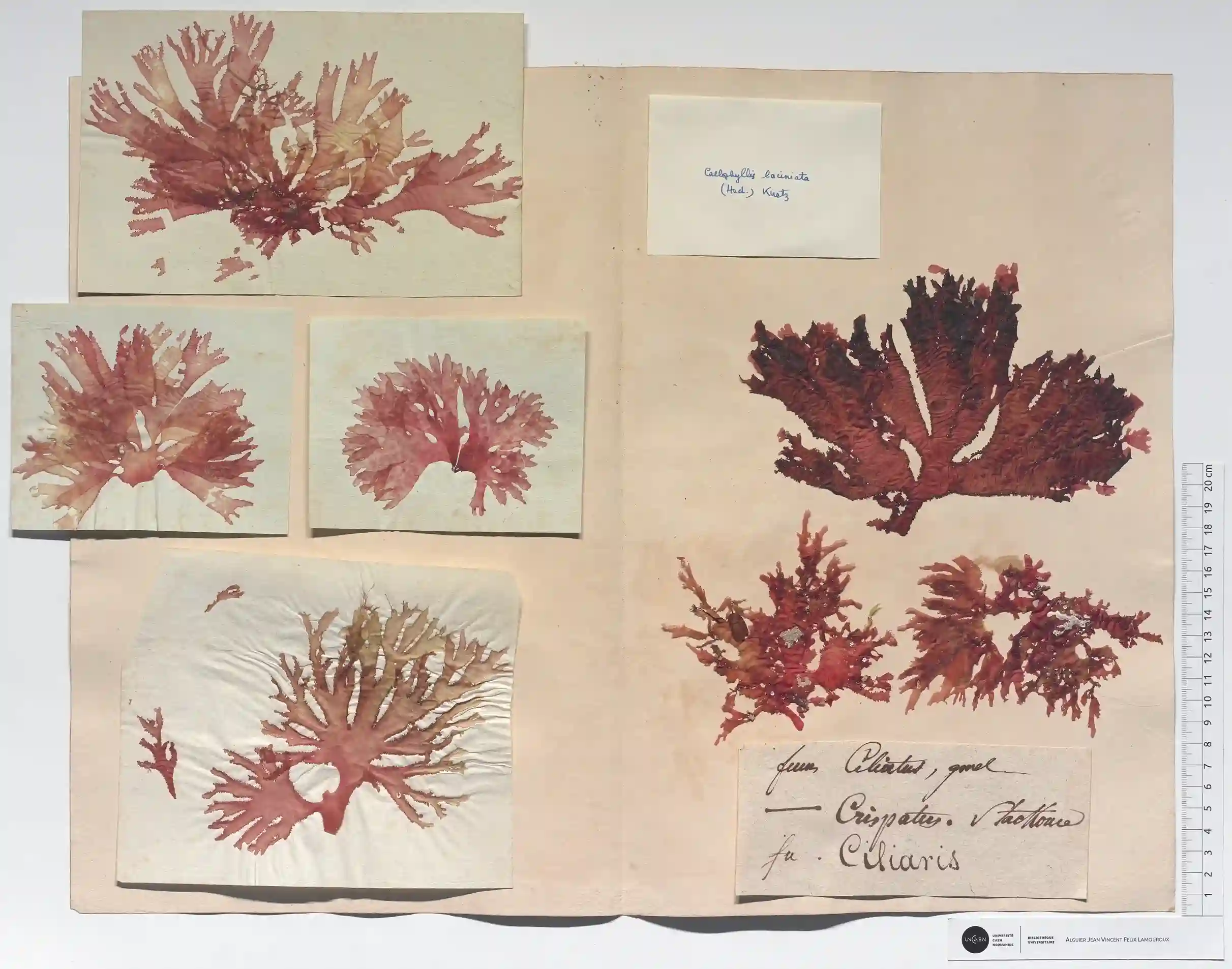
Among these collections is the seaweed herbarium of Jean Vincent Félix Lamouroux (1779–1825), Professor of Natural History at the Université de Caen, founder of the Linnean Society of Calvados, and Director of the Caen Botanical Garden. Lamouroux’s pioneering work on the classification and description of algae remains a landmark in phycology. His herbarium comprises specimens collected from around the world, many gathered during major scientific expeditions, through an extensive European network of correspondents including Jules Dumont d’Urville, Alire Raffeneau-Delile, Franz Carl Mertens, Dawson Turner, Jacques Labillardière, and René Louiche Desfontaines. Registered in the Global Registry of Scientific Collections (GRSciColl) under the code CN, this herbarium documents early nineteenth-century marine biodiversity and contains a significant number of holotypes, reflecting Lamouroux’s authorship of 43 genera and 576 species. Beyond its taxonomic importance, the collection also provides valuable insight into early scientific methods and the development of international research networks.


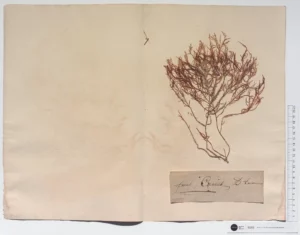
The internationally renowned seaweed herbarium of Sébastien René Lenormand (1796–1871) consists of specimens sent to him by botanists from across the world, forming an exceptional collection that extends the scientific legacy of Lamouroux’s herbarium.
Joseph François Chauvin (1797–1859), Lamouroux’s successor as Professor of Botany and Geology at the Université de Caen and President of the Linnean Society of Calvados, is the taxonomic authority for one genus and 65 species. In 1831, he published Algues de la Normandie, now available through Gallica, the digital library of the Bibliothèque nationale de France, while the original illustration plates are preserved by the University.
François Alexandre Pelvet (1801–1882), a specialist in cryptogams whose herbarium is frequently cited in the Bulletin de la Société linnéenne and the Bulletin de la Société botanique de France, conducted his research with the assistance of his wife, Aline Vivien. Her finely executed watercolour plates, depicting Pelvet’s microscopic observations, are preserved by the University and have recently been digitized. Together, they provide a remarkable record of the collaborative scientific practices developed by these Norman botanists.
The project pursues three complementary objectives: to ensure the long-term preservation of these unique collections through appropriate rehousing; to produce high-quality digital surrogates accompanied by essential metadata; and to make these resources openly accessible to both the international research community and the general public. The project is carried out by Céline Chuiton and Julie Garnier, coordinated by Louise Daguet (SCD, Université de Caen Normandie), with scientific oversight provided by Benoît Véron (MerSea).