Comparative ecotoxicity of aluminium-based galvanic anodes and impressed current on the Pacific oyster (Crassostrea gigas) larvae
By : Nesrine Zitouni, Katherine Costil, Jean-Luc Boudenne, Bruno Coulomb, Gaël Martin, Matthieu Dussauze, Antoine Serpentini, Christelle Caplat
In collaboration with: LCE Marseille and France Energies Marines.
ABSTRACT :
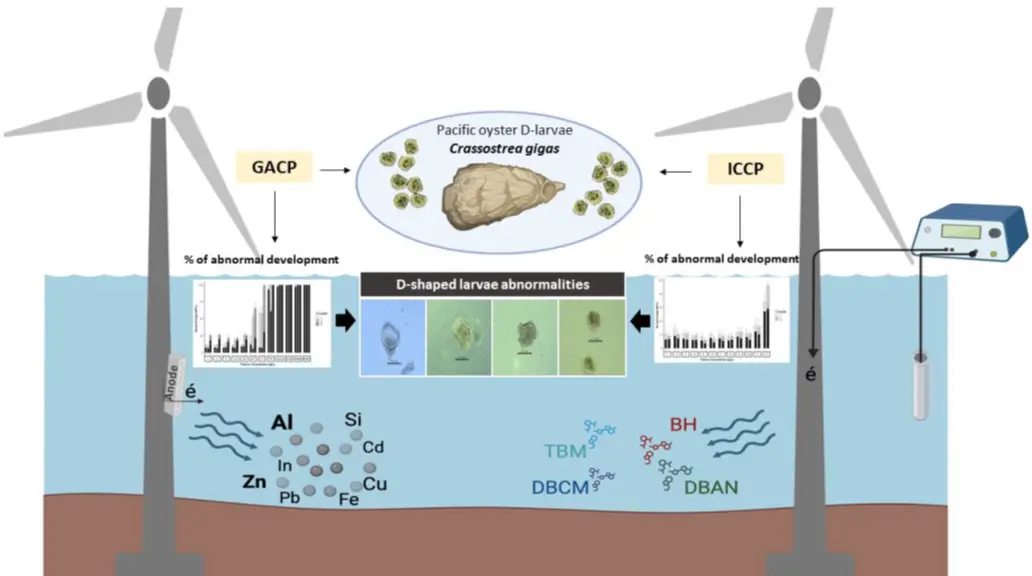
Cathodic protection using aluminium-based galvanic anodes (Al-GACP) or impressed current (ICCP) is widely used to prevent corrosion of steel structures immersed in seawater. These processes release a “cocktail” of compounds whose environmental impact remains poorly documented. In this study, the effects of the mixture of metals released by Al-GACP anodes and the by-products generated by ICCP systems were assessed in D-stage larvae of the Pacific oyster (Crassostrea gigas).
The ICCP system released chlorination and bromination by-products, including trihalomethanes, haloacetonitriles and haloaldehydes. Both cathodic protection systems induced dose-dependent effects on embryonic development, resulting in larvae unable to develop normally at concentrations exceeding threshold values ranging from 117 to 187 μg L⁻¹ for Al-GACP, and following exposure to a slightly diluted (1.6-fold) stock solution of ICCP by-products generated after 4 hours under static water conditions (without water renewal). Embryotoxicity assays also revealed inter-individual variability in the sensitivity of C. gigas broodstock to Al-GACP, with EC₅₀ values ranging from 63.4 to 110 μg L⁻¹.
These preliminary results highlight the need for further research into the ecological effects of chlorination by-products generated by ICCP systems through ecotoxicological studies. Such research is essential to help strike a balance between decisions regarding corrosion protection of offshore structures and the preservation of marine wildlife.