


Here the article translated :
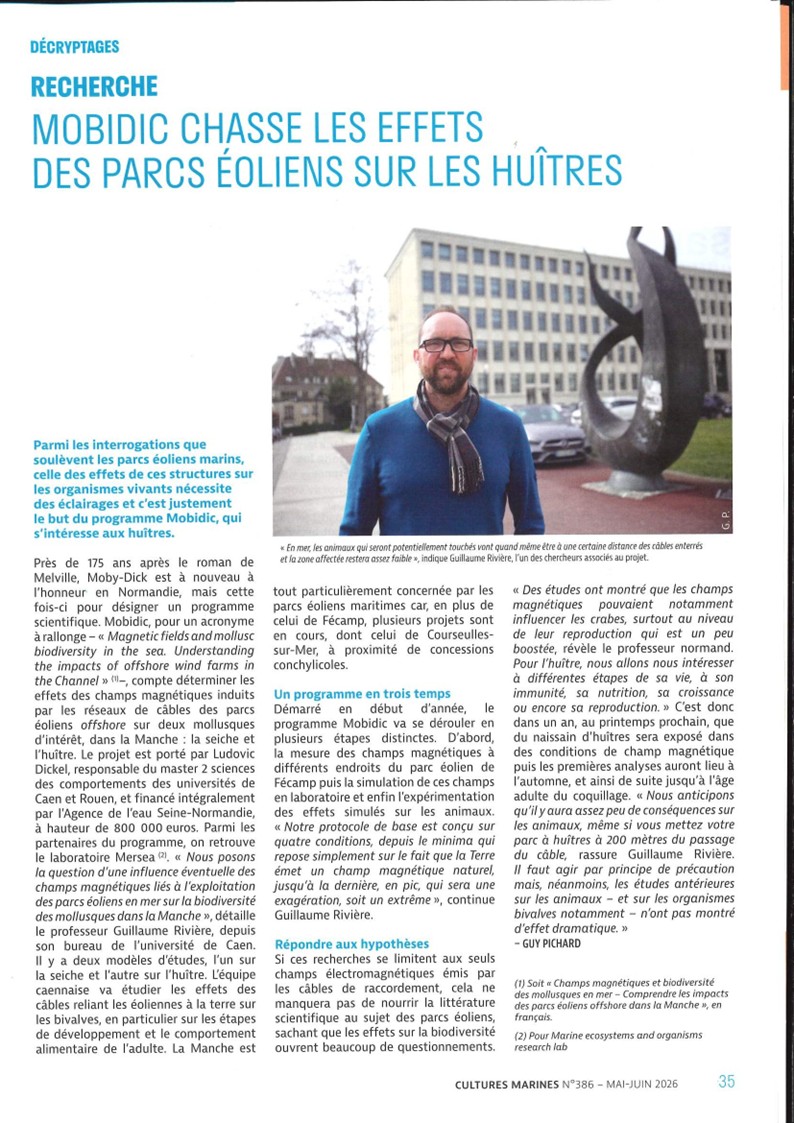
Among the many questions raised by offshore wind farms, the effects of these structures on living organisms require further investigation. This is precisely the aim of the MOBIDIC program, which focuses on oysters.
Nearly 175 years after Moby-Dick, the name is once again making waves in Normandy—this time as the title of a scientific research program. MOBIDIC, an acronym for “Magnetic fields and mollusc biodiversity in the sea. Understanding the impacts of offshore wind farms in the English Channel”, aims to determine the effects of magnetic fields induced by the cable networks of offshore wind farms on shellfish species in the English Channel, particularly oysters.
The project is led by Guillaume Rivière, professor of the Master’s program in Sciences at the Universities of Caen and Rouen, and is funded by the Seine-Normandie Water Agency with a budget of €800,000. Program partners include the MERSEA laboratory.
“We are investigating the possible influence of magnetic fields linked to offshore wind farm operations on mollusc biodiversity” explains Professor Guillaume Rivière from his office at the University of Caen Normandy. “There are two study models: cuttlefish and oysters.”
The Caen research team will study the effects of the cables connecting wind turbines to land on bivalves, particularly during developmental stages and adult feeding behavior;especially concerned by offshore wind farm projects and, beyond the Fécamp site, several projects are currently underway, including one near Courseulles-sur-Mer, close to oyster farming concessions.
A Three-Phase Program
Launched earlier this year, the program will unfold in several stages. First, researchers will measure magnetic fields at different locations around the offshore wind farm near Fécamp. Then, these fields will be simulated in the laboratory, before experimental testing is conducted on animals.
“Our experimental protocol is based on four conditions, ranging from the minimum magnetic field naturally emitted by the Earth to the highest level, which represents an exaggerated or extreme scenario,” explains Guillaume Rivière.
Testing the Hypotheses
While this research focuses on electromagnetic fields emitted by connection cables, it is also expected to contribute valuable scientific knowledge regarding offshore wind farms and their potential effects on biodiversity.
“Studies have shown that magnetic fields may influence crabs, particularly during reproduction, which can become more active,” explains the professor. “For oysters, we will examine different stages of their life cycle, including immunity, reproduction, and growth.”
As early as next spring, newborn oysters will be exposed to magnetic field conditions, followed by the first analyses in autumn and subsequent monitoring until adulthood.
“We do not expect major consequences for the animals, even if an oyster farm were located just 200 meters from a cable route,” reassures Guillaume Rivière. “However, as a precautionary principle, studies on animals—and especially marine organisms—have not shown any dramatic effects so far.”
— Article by Guy Pichard