



How nitrogen and phosphorus stoichiometry drive the physiology and photosynthesis of Scrippsiella acuminata (Dinophyceae)
Delatte, L., Massinot, C., Stoltz, G., Marais, F., Hernández-Fariñas, T., & Claquin, P. (2025). How nitrogen and phosphorus stoichiometry drive the physiology and photosynthesis of Scrippsiella acuminata (Dinophyceae). Journal of Phycology, 00, 1–16
The growth and development of microalgae are primarily supported by two essential nutrients: nitrogen (N) and phosphorus (P). While the limitation of a single nutrient has been widely studied, the balance between N and P availability remains less explored. Scrippsiella acuminata is one of the most abundant dinoflagellates in coastal ecosystems due to its physiological plasticity, making it a key species for understanding acclimation to unbalanced nutrient inputs. In order to test the acclimation of S. acuminata, semi-continuous cultures were exposed to six N:P ratios (1.6, 8, 16, 32, 90, 180). Parameters such as photosynthetic response, biovolume, carbon excretion, lipids, reactive oxygen species (ROS) production, cell cycle, and alkaline phosphatase activity were analyzed.
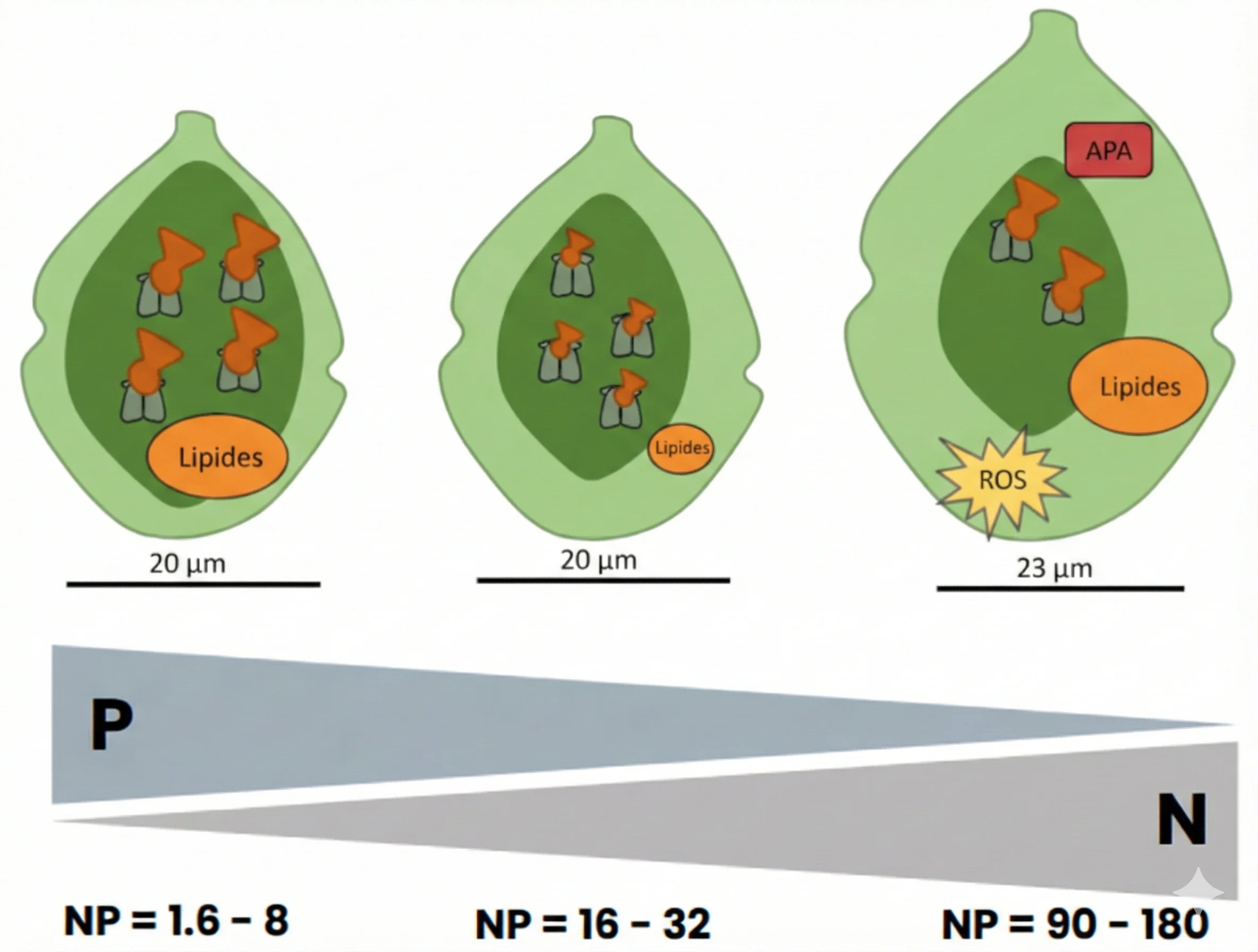
Active growth, a steady cell cycle progression, balanced carbon resource allocation, and high photosynthetic efficiency were observed at balanced N:P ratios (16, 32). At low ratios (1.6, 8), growth was reduced, but cells maintained active photochemistry, while high ratios (90, 180) resulted in a prolonged G1 phase, leading to an increase in biovolume and a limitation of the protective capacity of non-photochemical quenching (NPQ), resulting in the accumulation of reactive oxygen species.
Carbon allocation followed a stoichiometric gradient where more N:P limiting ratios favored the production of extracellular polymeric substances (EPS) and a cellular carbohydrate pool as an overflow mechanism to protect cells, while moderate limitation led to lipid accumulation as metabolic reserves. These results not only highlight the plasticity of S. acuminata to acclimate to nutritional stress but also suggest that this species may be more vulnerable in P-limited environments and possesses a competitive advantage when N is the main limiting factor.