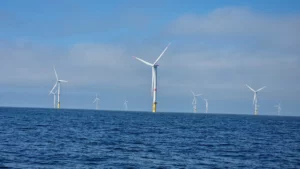
The EOL-REEF project is set within the context of high anthropization in the English Channel, an area subject to multiple environmental pressures where offshore wind farm development is rapidly expanding, particularly between Courseulles-sur-Mer and Fécamp. This zone is strongly marked by nutrient-rich inputs from the Seine estuary, which significantly influence primary productivity. The central objective of the project is to evaluate the reef effect induced by submerged wind turbine structures and to analyze its consequences on primary production as well as on the first trophic levels, specifically in this estuary-influenced area.
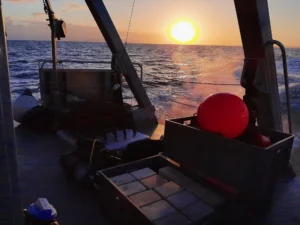
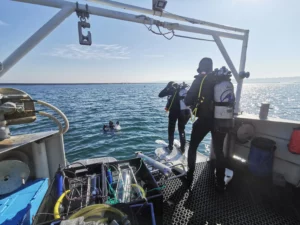
The project is structured around two complementary actions. The first action aims to detect a biogeochemical signal at the sub-mesoscale (<100 km), associated with reef effects on phytoplankton dynamics and primary production. Six annual campaigns will be conducted from 2026 to 2028 aboard the vessel NORMANDSEA, using a high-frequency spatio-temporal measurement system (physicochemical, biological, and isotopic parameters). This monitoring relies on innovative automated instrumentation for continuous characterization of primary production and planktonic diversity, integrating data rapidly through advanced processing automation.
The second action focuses on the detailed study of biogeochemical fluxes (carbon, nitrogen, phosphorus, silica) related to the reef effect, via an instrumented pilot site in the Bay of Seine monitored by three National Observation Services. This site includes experimental artificial structures, allowing for the analysis of bentho-pelagic flux coupling, trophic transfers, and functional diversity. Innovative approaches, combined with mesocosm experiments, will complete the analysis.
The project’s integrated approach, combining in situ observations and experimentation, will characterize processes and quantify fluxes essential for modeling the ecological impacts of offshore wind farms.