


Thanks to Stéphanie Lemaire, journalist at France 3 Normandie, for this article published on March 30, 2026, after the latest Maritime Event Café this March 26 :
“An invasive marine species loves to travel. Attached to the hull of a container ship or carried in ballast water, crossing oceans before settling in a new environment.”
On the Normandy coast, one area has drawn the attention of scientists: the stretch between Ouistreham and Caen. Nothing unusual can be seen above the water’s surface—which is only natural, as everything happens below the ships’ waterlines.This is how species from the other side of the world—such as small Australian worms or Mexican bivalves—end up establishing themselves in ports in Normandy and elsewhere.
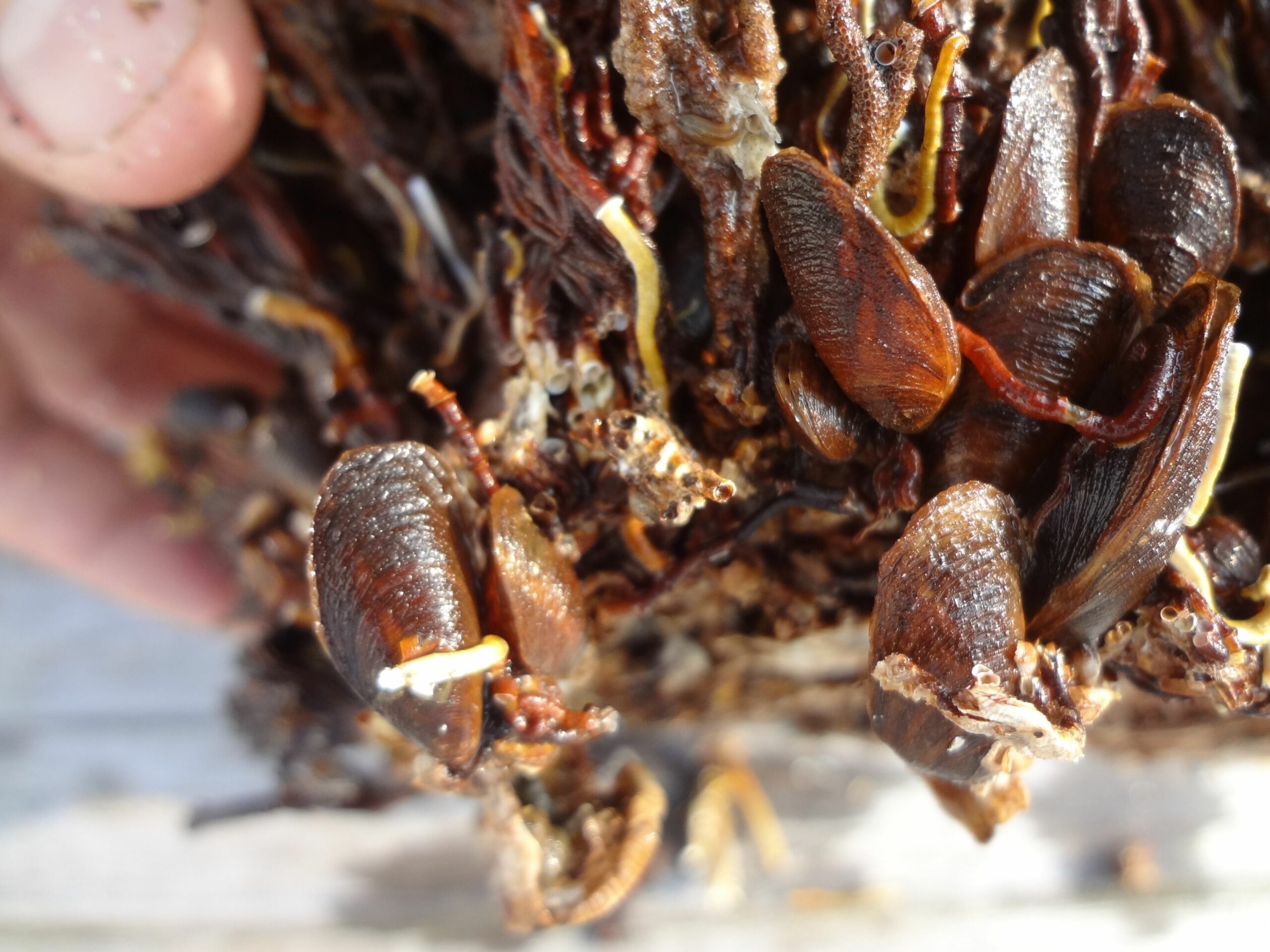
Seven species have been identified in the brackish waters (a mix of saltwater and freshwater) of this rather unique area. Some are tiny crustaceans. Others have caught the attention of Katherine Costil, a Mersea researcher at the University of Caen. “One of these species arrived as early as the late 19th century, in 1898. It is a small two-centimeter mussel—the false brown mussel—which came from the Gulf of Mexico.”
A small Australian worm nicknamed “Honfleur itch”
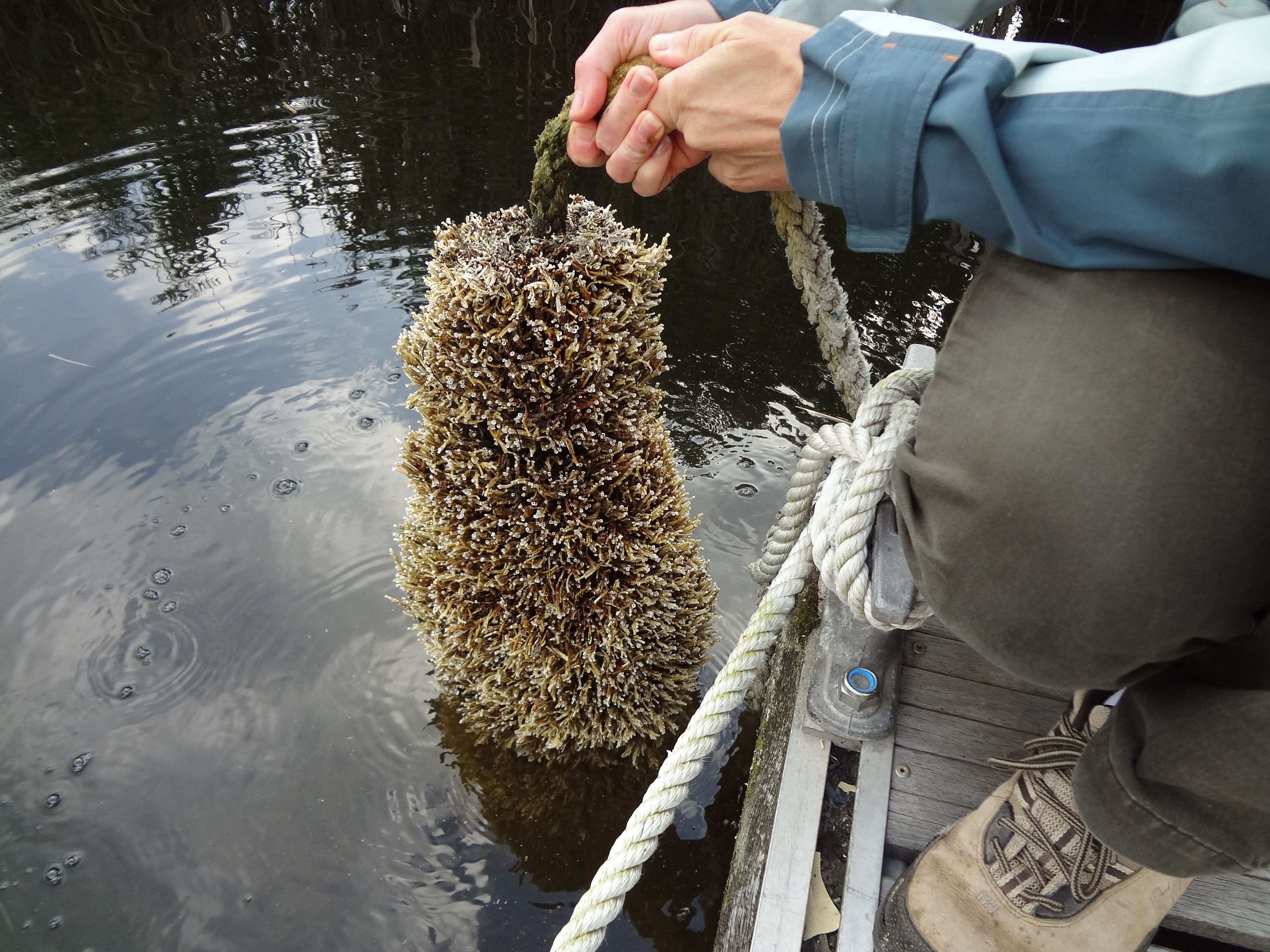
Another species, however, causes more problems, particularly for boaters in Honfleur. This is a tiny worm that came straight from Australia and has the unpleasant habit of building hard calcareous tubes. “In the old harbor, these clusters can reach up to 40 centimeters thick. It is nicknamed the ‘Honfleur itch.’” Cleaning boat hulls and port structures is enough to understand just how troublesome these calcareous tubes can be.
On the other hand, “this biological fouling—also known as biofouling—mainly causes problems for human activities. It is not necessarily an issue for biodiversity: this type of reef-like structure can host up to around fifteen species,” the scientist explains.
Among the invasive species mentioned, one more has recently been identified for the first time in the port of Ouistreham. This one raises fewer concerns for recreational boating than the worm.
It is rangia cuneata, a bivalve consumed in the Gulf of Mexico. ” This species spends most of its time buried in sediments, filtering the water column. “We believe it helps purify water masses and accumulates a large amount of pollutants,” adds Katherine Costil.
“This environment does not have a large number of competitors, so the bivalve likely has not displaced another species. However, it would be problematic if it were to proliferate in shellfish farming areas, for example, due to its impact on phytoplankton. In that case, there would be competition with human activities.”
The real battleground is ship hulls
Humans are actively fighting some of these species. This is where biofouling comes back into play. Major companies in the region are looking to eliminate mussels and other organisms that attach to ship hulls. “We compared plates coated with an anti-corrosion layer to others treated with antifouling paint. The monitoring took place at sea over 15 months,” explains Katherine Costil.
The result: 30 times fewer macro-organisms on plates treated with antifouling coatings. However, smaller organisms remain. “Yet it is essential to minimize bacteria and microalgae in order to reduce friction on hulls.” The outcome of this naval battle remains uncertain.
A relative notion of “invasive” species
In the end, a species described as invasive sometimes is so “from a perspective very much centered on humans and their interests,” the researcher notes. “We observe that these are species resistant to pollution, not very demanding, and equipped with highly efficient reproductive systems.”
After an initial boom phase (or “bloom”), their populations tend to regulate themselves, decline, and return to more balanced levels. Only one species out of a thousand becomes truly invasive—so large-scale overrun is not expected anytime soon.”
Overall :
Ports: ideal gateways for invasive species
Ports are particularly favorable environments for these species. Ships constantly come and go, bringing with them organisms that latch onto hulls or survive in ballast tanks. Once released, these species can adapt and sometimes proliferate. Artificial structures in ports—like docks, pilings, and quays—also provide surfaces where these organisms can easily attach and grow.
Species that travel… and sometimes invade
Not all introduced species become invasive. Many fail to adapt. But some thrive due to favorable conditions: lack of predators, suitable temperatures, and abundant resources.
Among the species observed are:
- small worms originating from Australia,
- bivalves from Mexico,
- and other organisms capable of forming dense colonies.
Some of these species can cover large surfaces and disrupt local ecosystems.
Human activity at the heart of the phenomenon
Global maritime trade is the main driver of these biological invasions. Ships act as vectors, unintentionally transporting living organisms across continents.
Climate change also plays a role: warmer waters make it easier for species from distant, often warmer regions to survive and reproduce in European waters.
A growing environmental challenge
Scientists are monitoring these species closely, especially in port areas where introductions are most frequent.
The challenge now is to better understand these introductions and limit their spread—because once established, these species are extremely difficult to eradicate.