



Comparing Macroscopic and Quantitative Histological Methods to Determine Sexual Maturity in the Female European Plaice, Pleuronectes platessa Linnaeus, 1758
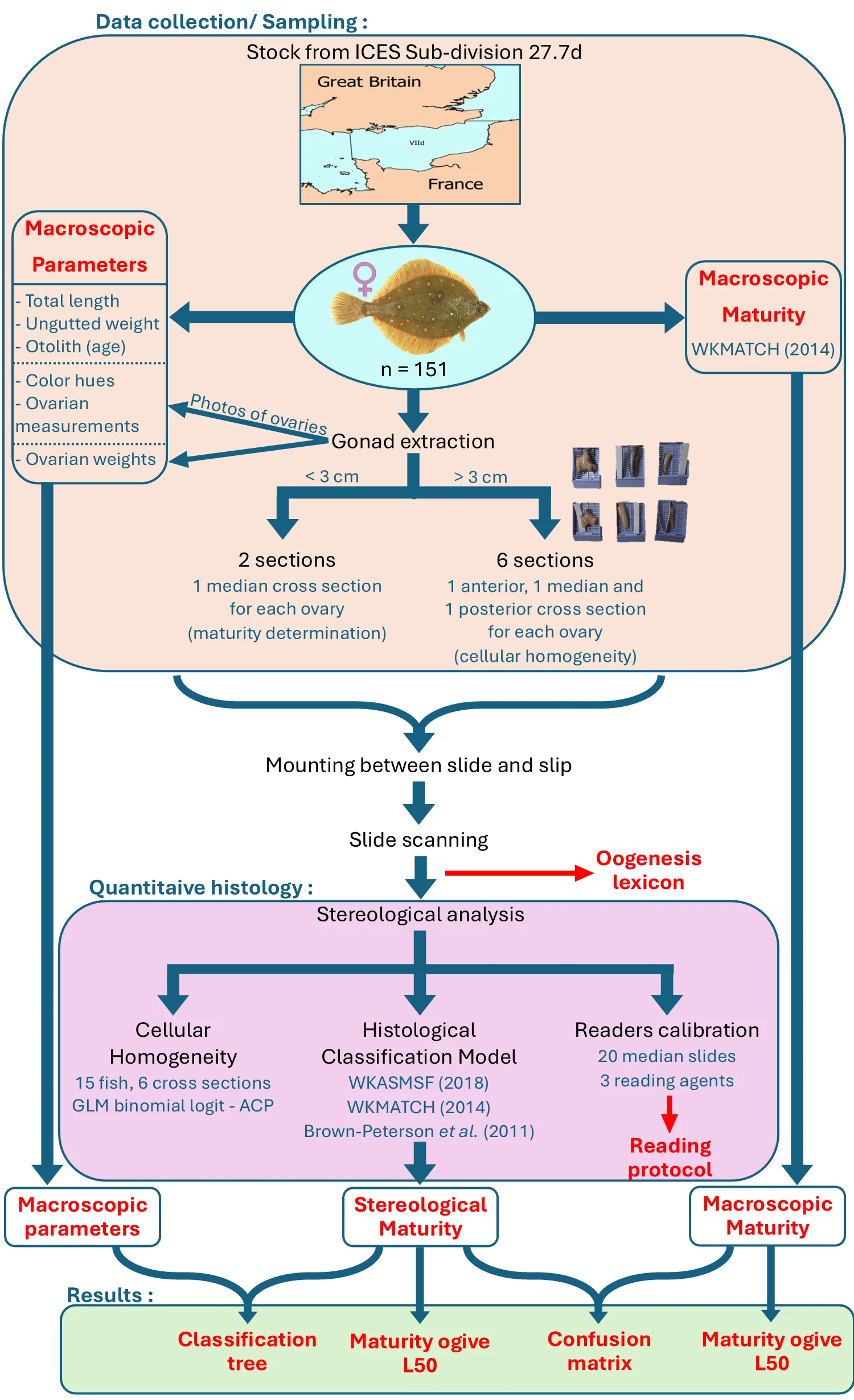
To implement regulations in fisheries, such as minimum catch size for a species, data on the biological parameters of the species must be collected and analyzed. Among these parameters, the sexual maturity of fish is assessed. Several methods exist, and in this article, we used the macroscopic method (visual assessment of the sexual organ to classify the fish into a maturity stage) and the stereological method (identification and counting of cells within the fish’s sexual organs to determine the maturity stage).
The proposed methods aim to minimize subjectivity introduced by the human operator who determines the maturity stage, through the implementation of guidelines and calibration exercises. Beyond reducing human evaluation bias, this article also shows that the macroscopic method, used to collect data later exploited to establish fishing regulations, accurately determines the sexual maturity of female plaice in only 40.4% of cases.
This leads to estimates of size at first maturity of 28.6 cm using the macroscopic method versus 20.6 cm using stereology—differences that could have a major impact when establishing fishing regulations.